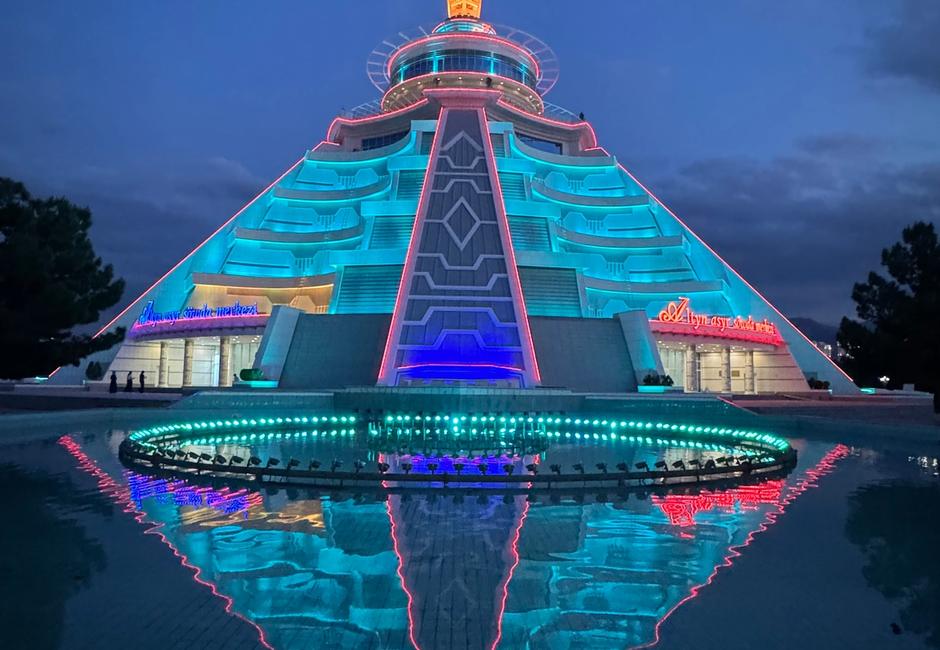
Marble Architecture of Ashgabat
Ashgabat, the capital of Turkmenistan, is one of those cities that feels almost unreal when you first hear about it—an urban landscape rising from the edge of the Karakum Desert and stretching toward the foothills of the Köpetdag Mountains. Sitting in southern Turkmenistan, not far from the Iranian border, it occupies a strikingly dry yet strategically important crossroads of Central Asia, where ancient Silk Road routes once connected traders, empires, and cultures. Although the city was originally founded in 1881 as a Russian imperial outpost, its appearance today tells a much more recent story. Much of the original settlement was destroyed by a powerful earthquake in 1948, an event that reshaped not only the city's architecture but also its identity. In the decades that followed—especially after Turkmenistan gained independence—the city was rebuilt on a massive scale, with grand boulevards, monumental buildings, and an architectural style that leans heavily toward white marble and wide-open space. This transformation eventually led to Ashgabat being widely known as the 'White Marble City,' a nickname reinforced in 2013 when it was recognized by Guinness World Records for having one of the highest concentrations of white marble buildings anywhere on Earth. Walking or driving through Ashgabat today, the effect is striking: long, unusually clean avenues lined with gleaming government buildings, cultural centers, and oversized monuments that reflect the country's modern national identity. Among the most recognizable landmarks are the Monument of Neutrality, symbolizing Turkmenistan's foreign policy stance, and the Alem Cultural and Entertainment Center, home to one of the largest indoor Ferris wheels in the world. The city's design is highly planned, giving it a spacious and orderly feel that contrasts sharply with many older, denser cities in the region. Geographically, Ashgabat is shaped by its environment as much as its architecture. The nearby Karakum Canal, one of the most important infrastructure projects in the region, brings water from the Amu Darya river across vast stretches of desert to support agriculture and urban life. This lifeline has been crucial in sustaining development in such an arid climate. The surrounding landscape also offers dramatic views, especially from higher points near the city, where modern buildings meet desert horizons and mountain silhouettes. The meaning of the city's name adds another layer of intrigue. 'Ashgabat' is often interpreted as 'City of Love' or 'City of Devotion,' though some historians suggest it may be linked to Arsaces I, founder of the Parthian Empire—hinting at deeper historical roots beneath the modern cityscape. Over time, Ashgabat has also become a symbol of national celebration and identity, with May 25th marked annually as City Day, highlighting its relatively recent but carefully curated urban history. What makes Ashgabat especially memorable is the contrast it embodies: a city built on ancient land, shaped by Soviet-era reconstruction, and then reimagined again in the modern era as a showcase of national ambition and architectural spectacle. For travelers and curious observers alike, it offers a rare glimpse into a place where history, symbolism, and futuristic design converge into a single, highly distinctive urban experience.
Year-round
Half day to full day
Highlights
Travel Tips
- •Photography of government buildings may be restricted — ask your guide first
- •Dress neatly — casual beachwear is frowned upon in the city center
- •Early morning or evening offers the best light for photos and cooler temperatures